News Software-based Networks

Cancel
  • Portraitbild: Marius Corici, Fraunhofer FOKUS, stellv. Geschäftsbereichsleiter Software-based Networks
    © Philipp Plum / Fraunhofer FOKUS

    Artificial intelligence no longer merely supports humans in individual tasks. With so-called Agentic AI, it can make decisions autonomously, develop code, and orchestrate complex workflows. The new Agentic Core demonstrates the advantages AI offers for communication networks and how safety and reliability can be ensured at the same time. The Software-based Networks business unit will present the Agentic Core at Mobile World Congress in Barcelona in early March. Dr. Marius Corici, Director of the business unit, explains in the interview how Agentic AI is paving the way for future 6G networks – and which challenges still need to be addressed

    more info
  • Treppenhausstruktur gläsern, Froschperspektive
    © iStock / Mlenny

    With the launch of Open6GHub+, Germany will have a national 6G transfer hub as of January 1, 2026. It closes the gap between 6G basic research and economic and social impact. Fraunhofer FOKUS offers 6G core network technologies, AI-based core networks, and digital twins of networks and applications in the hub, which can be used to test and optimize new services.

    more info
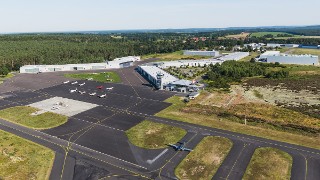
  • Luftaufnahme des Fluplatzes Schönhagen
    © Flugplatz Schönhagen

    Fraunhofer FOKUS designed a private 5G campus network at the Otto Lilienthal Research Airfield in Schönhagen (Brandenburg) and implemented it in collaboration with the department of Aviation Management at TH Wildau, “Flugplatz Schönhagen – Forschungsflugplatz Otto Lilienthal”, and MIT GmbH. The multi-vendor network serves as a test environment for use cases and new 5G functions. Fraunhofer FOKUS will present this reference implementation at PMRExpo in Cologne from November 25 to 27, 2025.

    more info
  • Portraitbild: Marius Corici, Fraunhofer FOKUS, stellv. Geschäftsbereichsleiter Software-based Networks
    © Philipp Plum / Fraunhofer FOKUS

    Non‑terrestrial networks (NTN) are being incorporated into 6G for the first time from the outset of the standardization process. In this interview Dr. Marius Corici, deputy director of the Software‑based Networks business unit, explains the benefits and operation of such a super network.

    more info
  • Mehrere Roboterarme in einer Flaschenfabrik
    © iStock / Kinwun

    Fraunhofer Institute FOKUS in partnership with Deutsche Telekom AG and MediaTek Inc. has successfully integrated TSN standards into a 5G test network. A complete end-to-end TSN system for private 5G networks is provided, spanning from the software-based core network through the radio access network (RAN) to the user equipment. It is suitable for applications requiring deterministic data packet communication, such as robot control in factory shopfloors.

    more info
  • Baustelle mit Bagger
    © Fraunhofer HHI

    To mark the conclusion of the CampusOS flagship project, 22 partners from industry and research have published a guideline for the development and operation of open and modular 5G campus networks. These networks offer an alternative to the monolithic solutions of established providers and, through their Open RAN-based approach, promote the digital sovereignty of European companies. 5G campus networks can be deployed in various sectors, such as logistics, construction, manufacturing, agriculture, and healthcare.

    more info
  • Wissenschaftler arbeitet am Nomadic Node
    © Paul Hahn / Fraunhofer FOKUS

    The lead project CampusOS, funded by the Federal Ministry for Economic Affairs and Climate Action, will be showcasing how to successfully set up and operate a 5G campus network in industry at the Hannover Messe in the 5G Arena (Hall 15, booth H13) from April 22-26, 2024. Experience the new possibilities using representative application examples in Industry 4.0, logistics and robotics, safe teleoperated driving, on construction sites or in the clinic networked with 5G.

    more info