Projects

Cancel
  • m4guide

    mobile multi-modal mobility guide

    Eine blinde Person liest Informationen an einem Geländer am Berliner Hauptbahnhof in Braille-Schrift
    © Matthias Heyde / Fraunhofer FOKUS

    The project m4guide aims to develop and test a seamless travel, information and navigation system for standard smartphones.

    more info
  • KI-FLEX

    Reconfigurable hardware platform for AI-based sensor data processing for autonomous driving

    Kofferraum eines silbernen Autos, das mit Hardware zur Ermöglichung des Autonomen Fahrens ausgestattet ist.
    © Fraunhofer FOKUS

    The partners working on the research project “KI-FLEX” are developing a powerful, energy-efficient hardware platform and the associated software framework for autonomous driving.

    more info
  • DIGINET-PS

    The Digitally Connected Protocol Route - Urban Test Field for Automated and Connected Driving in Berlin

    Simulation der DIGINET-PS Teststrecke in Berlin mit VSimRTI
    © Kai Royer / Fraunhofer FOKUS

    In the DIGINET-PS project, connected and automated driving is researched in the urban test field of Berlin. The focus is on combining modern smart city technologies with future vehicles.

    more info
  • Visit the train station, enter the locomotive, shoot inside and look away from the locomotive
    © iStock / zhangxiaomin / Fraunhofer FOKUS

    The project “Berliner Digitaler Bahnbetrieb” (BerDiBa) tests and develops technologies for automated driving on railroads. Fraunhofer FOKUS will use its expertise in environment perception for automated vehicles and adapt its artificial intelligence tools for traffic on rails.

    more info
  • Ein Mann auf einem Fahrrad fährt durch eine sehr schmale Lücke zwischen zwei Bussen.
    © Philipp Plum / Fraunhofer Fokus

    In the Reallabor Hamburg (RealLabHH) the mobility of tomorrow will be tested in the here and now of a metropolis in order to create a blueprint for the digital mobility of the future. Fraunhofer FOKUS is developing with partners a digital collision warning system for vulnerable road users such as cyclists and e-scooter drivers.

    more info
  • Shuttles&Co

    Digital test field Berlin

    Collage: Blick durch die Frontscheibe eines Linienbusses (ausgegraut), eingefügt darin ein Ausschnitt der Echtzeitverkehrsanalyse durch die im Projekt Shuttles&Co entwickelte App auf einem Smartphone.
    © Fraunhofer FOKUS

    In Reinickendorf, Berlin, automated vehicles and new communication technologies are used to test and further develop safety and comfort in digital urban traffic.

    more info
  • Ein blinder Mann mit Hut, Sonnenbrille und Langstock steht an einer Bushaltestelle.
    © Shutterstock / Halfpoint

    During the “Ride4All” project, a model route for barrier-free public transport will be established over the next two years. Users will travel from the Soest to Paradiese station in automated minibuses, while being accompanied by a inclusive, highly accurate app.

    more info
  • Location-as-a-Service

    Location-as-a-Service for a highly accurate localization

    »Location-as-a-Service« (LaaS) hilft bei der Vernetzung verschiedener Verkehrsteilnehmer.
    © Philipp Plum / Fraunhofer FOKUS

    Assistance systems, such as GLOSA, collision warning, and Digital St. Andrew's Cross, can increase safety and comfort for road users, but also improve efficiency. For these assistance systems to be available to VRUs (“Vulnerable Road Users”) as well as passenger cars, highly accurate positioning is necessary. It is crucial to assign road users to the correct lane on a road, for example, to determine the correct traffic light sequence or to detect a possible collision.

    more info
  • Curbside Management

    The curb as a neuralgic point in traffic

    Ein kleines Auto parkt am Straßenrand zwischen zwei großen Containern für Bauschutt. Im Hintergrund sind auf den Gehweg ein Biefeinwurfkasten und ein Stromverteilerkasten zu sehen.
    © Philipp Plum / Fraunhofer FOKUS

    Curbside space is an important ressource in urban traffic, but its availability is limited. To provide a more transparent and flexible use, the Smart mobility team is developing a curbside screening solution that integrates diverse sensor sources to provide an accurate picture of the current road situation.

    more info
  • ConnRAD

    Connectivity & resilience for automated driving functions in Germany
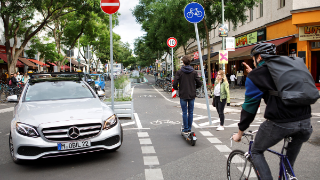
    Eclipse Mosaic zum Schutz von Verkehrsteilnehmenden.
    © Philipp Plum / Fraunhofer FOKUS

    The ConnRAD project aims to develop system architectures as well as communication protocols and mechanisms to increase reliability and resilience for connected, safety-critical driving functions as part of connected mobility (C-ITS, CCAM).

    more info