Smart Mobility News

Cancel
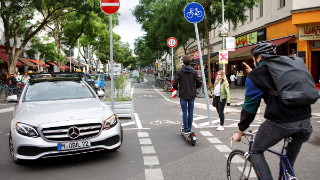
  • Zwei Lieferfahrzeuge parken in einigem Abstand zueinander in zweiter Reihe neben vielen parkenden Autos
    © Philipp Plum / Fraunhofer FOKUS

    Digital curbside management optimizes curbside parking by enabling dynamic time slots for delivery vehicles, taxis, etc. The Smart Mobility team at Fraunhofer FOKUS has developed a smartphone-based curbside screening solution that integrates diverse sensor sources in the street space to obtain an accurate picture of the current street situation.

    more info
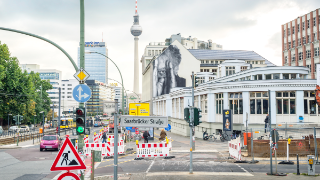
  • Berlin, Germany - September 12, 2013: Urban scene in Prenzlauer Allee street in Berlin with mural from the project Wrinkles of the city by artist JR, Tv tower and traffic
    © istock / Zorana Lalic

    The Smart Mobility team at Fraunhofer FOKUS has developed new components for Eclipse MOSAIC in order to evaluate different traffic state estimation systems in a simulation. After all, optimal routing through the city is only possible if the current traffic situation is known precisely. This avoids congestion and promotes sustainability.

    more info
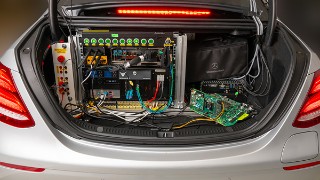
  • Kofferraum eines silbernen Autos, das mit Hardware zur Ermöglichung des Autonomen Fahrens ausgestattet ist.
    © Fraunhofer FOKUS

    How can autonomous driving be made more reliable? Yesterday, the “KI-FLEX” project presented its research results. The initiative was built around a high-performance, energy-efficient, and yet flexible hardware platform with the corresponding software framework, which uses AI technology to process and fuse data from various sensors. This allows vehicles to perceive and localize environmental stimuli in a manner that is fast, efficient, and reliable.

    more info
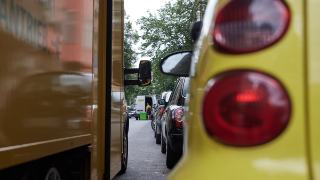
  • Eclipse Mosaic zum Schutz von Verkehrsteilnehmenden.
    © Philipp Plum / Fraunhofer FOKUS

    There are times in traffic situations when cyclists are difficult to detect even for the most advanced vehicle sensors - for example, when they are obscured for a few seconds by a stopping bus. In the project Reallabor Hamburg Fraunhofer FOKUS used its Eclipse MOSAIC simulation framework to demonstrate that uninterrupted object detection can be achieved by fusing LIDAR data from multiple automated cars, thus providing even better protection for particularly vulnerable road users in the future.

    more info
  • »Location-as-a-Service« (LaaS) hilft bei der Vernetzung verschiedener Verkehrsteilnehmer.
    © Philipp Plum / Fraunhofer FOKUS

    To warn drivers of a collision with a cyclist, an e-scooter rider of road damage, or to guide a blind person to the right government office or the bus door, highly accurate localization is always of fundamental importance. Fraunhofer FOKUS will be presenting its “Location-as-a-Service” at the ITS World Congress in Hamburg from October 11 to 15, 2021, at the “Reallabor Hamburg” project booth in Hall B2.

    more info
  • Eine digitale Nachstellung einer Straße.
    © Fraunhofer FOKUS

    On the occasion of EclipseCon 2020, Fraunhofer FOKUS launches its simulation environment Eclipse MOSAIC. This solution is based on VSimRTI (Vehicle-2-X Simulation Runtime Infrastructure), which has been developed over the last 12 years in close cooperation with the DCAITI of the TU Berlin and has already been used by more than 600 partners to test mobility services and traffic scenarios. Eclipse MOSAIC is now partially available as open-source.

    more info
  • Traffic on highway A 5 in Germany. Toned picture.
    © istock / Bernd Wittelsbach

    In the three-year EU project INFRAMIX, simulations and real field tests on motorways in Austria, Spain and Germany have shown that digitalization and communication form an efficient bridge between conventional and automated vehicles, thus enabling mixed traffic. Fraunhofer FOKUS used its simulation environment Eclipse MOSAIC (formerly VSimRTI) in the project and developed it further.

    more info
  • Ein blinder Mann mit Hut, Sonnenbrille und Langstock steht an einer Bushaltestelle.
    © Shutterstock / Halfpoint

    In the “Ride4All” project, a model route for barrier-free public transport will be established over the next two years. Users will travel from Soest to Paradiese station in automated minibuses accompanied by an inclusive app with barrier-free operation. The project is funded by the Federal Ministry of Transport and Digital Infrastructure with 2.3 million euros.

    more info
  • Paralleldarstellung Auswertung Sensor- und Kameradaten zur Aktualisierung der Straßenkarte
    © Fraunhofer FOKUS

    An always up-to-date, highly accurate digital map is essential for automated, connected driving. In the project “Safari: Digital Test Field Urban Traffic”, Fraunhofer FOKUS and its partners have been developing software over the last two and a half years that detects changes, such as missing signs or new road works, on the road to enable a self-updating, open map of Berlin.

    more info
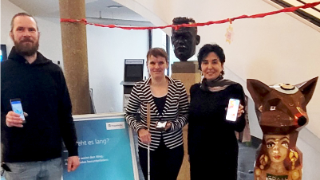
  • everGUIDE im Haus der Gesundheit und Familie in Berlin-Tempelhof; Model: Stephan Heinke, 2019
    © Philipp Plum / Fraunhofer FOKUS

    From now on, a digital assistant will accompany customers in the House of Health and Family (“Haus der Familie und Gesundheit”) of the Tempelhof-Schöneberg District Office in Berlin-Mariendorf to the specific room they are looking for. For the first time everGuide, a free indoor navigation system, which is able to guide even blind people safely thanks to its high precision, is being used in a public authority in Germany.

    more info
  • Berlin, Germany - August 12, 2014: view to the Strasse des 17. Juni in Berlin, Germany. In the far visible the Siegessäule.  a lot of cars standing at traffic light, people waiting
    © iStock / Kerstin Waurick

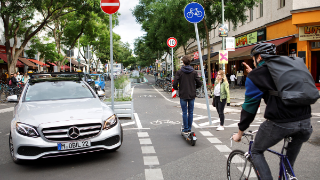
    On 19 September, the 3.6-kilometer test track between Ernst-Reuter-Platz and Brandenburger Tor was opened after 29 months of preparation. Fraunhofer FOKUS, in cooperation with DCAITI of TU Berlin, offered test drives in automated cars and demonstrated the advantages of vehicle-to-x communication, such as warnings of hazards at construction sites and cyclists.

    more info
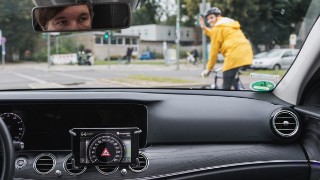
  • Fahrzeugdisplay mit Baustellenwarnung
    © Fraunhofer FOKUS

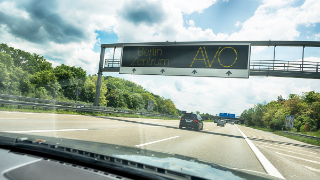
    Direct communication between vehicle and vehicle, as well as vehicle and the road, can contribute to avoid traffic jams and accidents in the near future and increase safety for all road users. With various live demonstrations, the 5G Automotive Association (5GAA) demonstrated its vision for intelligent and safe mobility today in Berlin based on the C-V2X technology (Cellular Vehicle-to-Everything).

    more info
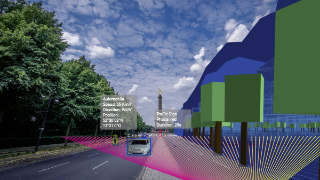
  • Montage der Straße des 17. Juni zum Großen Stern: Realbild und Animation aus Labelingtool für autonomes Fahren
    © Daniel Magda, shutterstock / Fraunhofer FOKUS

    The inaugural meeting of the working group openMobility took place today in Berlin-Adlershof. Apart from Fraunhofer FOKUS the first members include the German Aerospace Center, Bosch and Vector Informatik. The aim is to develop an open framework for the simulation of mobility scenarios and applications for research and industry.

    more info
  • Große Solartankstelle Carport mit Elektroauto in Stadt
    © AdobeStock / Petair

    Fraunhofer FOKUS has been researching the topic of environmentally friendly mobility in the city for years and is now participating in the joint project “LamA - Laden am Arbeitsplatz” (“LamA - Charging at the Workplace”), which aims to significantly expand the charging infrastructure for electric vehicles in communities with particularly high nitrogen oxide values, including Berlin. The researchers will also be demonstrating how connected-automated electric mobility can be achieved on 5 and 6 December during the closing event of the project “iKoPA - integrated cooperation platform for automated electric vehicles”.

    more info
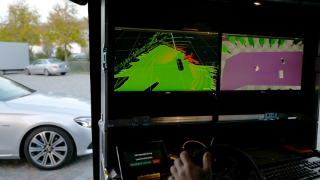
  • Eine mobile Kontrollstation für Teleoperiertes Fahren mit 2 Bildschirmen und einem Lenkrad in einer Tiefgarage mit einem silbernen Fahrzeug im Hintergrund.
    © Fraunhofer FOKUS

    At NVIDIA’s GPU Technology Conference (GTC) from October 9th – 11th, 2018 in Munich, Fraunhofer FOKUS researchers will demonstrate on the outdoor exhibition grounds how they can control a vehicle tele-operatively with minimal latency. That helps to bridge the gap from driver-controlled to fully autonomous vehicles. In addition, they will present their semi-automated tool for processing image data from Lidar laser scanners and cameras for training the artificial intelligence (AI) of smart cars.

    more info
  • Straßenkreuzung am Alexanderplatz bei Nacht
    © Fraunhofer FOKUS/ Bernhard Schurian

    LTE-Vehicle-to-anything (V2X) is the new specification for the direct traffic related communication. Fraunhofer FOKUS integrates the first commercial LTE-V2X-products from Huawei, which provide the network technology in the roadside base stations and in the cars, into their digital urban traffic test field in Berlin. Vehicles, for example, can be warned even faster of a breakdown vehicle.

    more info
  • Der Studentin mit dem besten Testfahrt-Ergebnis wird ein Preis überreicht. Auch der Zweitplatzierte wird von FOKUS-Forscher Daniel Becker bei der Siegerehrung gewürdigt.
    © Fraunhofer FOKUS

    As part of the iKoPA project, Fraunhofer FOKUS is developing an interactive simulator for the virtual testing of automated driving and for the analysis of user acceptance. To this end, various driving scenarios were created in which students of the TU Berlin had to monitor the system behavior and intervene in difficult situations. The student with the best test drive result was awarded a prize.

    more info